Sunday, 6 March 2011

Magic Show - Discussion with a Creationist.


During my second year at University, I had sufficient time to engage in a couple of email debates with a friendly creationist under the name Dr Dino (yes the irony is outstanding). Since this blog is on communicating geosciences and creationists need some talking too I’ve popped this on here, the communication is about two years old, but still gives a good review of emailing a creationist and discussing ideas with them. If you have a lot of time on your hands then this could be entertaining.

I am not trying to insult anyone, simply being curious.  It's a bit text heavy, so I've added some nice pictures. 

(ME)

Right, well as a geologists I view creationism, as complete rubbish; I would like to present why I think you and other people like you are holding onto creationism with such a strong hold.

essentially you don't want to see the bible being eroded away by fact, you view that evolution should be 100% complete and have no holes in it, I'll admit there are holes in it, we haven't found every missing link for example. the bible to you, is the word of God, no problem there (should point out I'm strongly atheist) your bible is, to you 100% accurate, if there are any holes in it people might stop believing etc etc.

Never mind it was written 2000 years ago, borrowing stories from around the region blended delicately with whatever the author thought sounded good; I'm not saying the bible is all wrong,I live a fairly moral life, which I would think has borrowed aspects of the bible (I live in the Uk and our law is based on Christianity) but it is just a story book, that people believed, I'm sure you laugh at Scientology and their wacky story of creation, that too is a story; what if 2000 years from now Scientology and its Zenon God of whatever somehow makes it into the 'mainstream' will people like you try to teach it to children?

There is bugger all evidence for Creationsism that cannot be explained with correct science which has been presented and reviewed. Creationsists point to the Grand Canyon being formed in a weekend, by a raging torrent, never mind theere is 500ft of Granite and basalt which almost unlimited water couldn't shift in a weekend (need chemical reactions to change the feldspar in the granite and basalt into clay minerals which are then carried away in water, once the feldspar has gone the granite breaks down); there are a million and one examples which nicely break away your arguemnts,

I look forward to hearing from you for intelligent debate about Creationism and its flaws (I'll take evolution too!)


Jack


(DR DINO)

Dear Jack,

It is your right to stand against good science if you so choose .... until you die and then answer to God.

Well, either "every action has an equal and opposite reaction" or ... there can be "something from nothing for no reason."

Take a look at our Debate Series: http://shopping.drdino.com/view_item.php?id=629DVD


Creationists contend that we are the ones siding with science. We do not need "hocus pocus" like the Big Bang theory to presume something from nothing for no reason.

After all, which is the bigger miracle, that God created the universe from outside of it, or that nothing (defying the laws of science) created the universe?

Evolutionists like to contend that creationists are the ones resorting to miracles. And they further contend that they side with science. And yet how, under their theory, did molecules - all by themselves - decide to become more and more complex? Was gravity (by accident) present at the Big Bang, or did it evolve itself into existence later? Was it everywhere at once, or did it start in one place and then spread itself out (for no reason)? Is the same true for angular momentum? Was all of the light spectrum originally in existence, or did it "evolve" over time? Why are the laws of science consistent today (given evolution?s belief in magic in the past)?

If you put an empty box into an attic and left it there for 50 years, what are the chances - scientifically speaking - that a "Little Bang" would happen inside during that 50 years? Such a belief is not scientific, but rather religious in origin. 

Sincerely, Paul Abramson


(ME)

Dear Paul,


Thankyou for informing me of what will happen when I die, its nice to know that you subscribe fully to scientific beliefs, with a friendly metaphysical being there to reprimand me for using free thought which I was blessed with, damn, hats bad. I love the way you wish to present yourself as a scientist; yet hold onto a metaphysical belief system handed down from 2000 years ago – and good science? What good science? Reading a 2000 year old text that scouring the globe to desperately find details for it; ignoring all modern ideas (or twisting them so far they are unrecognisable) just because you do not want to see your faith eroded. I fail to see a single peer reviewed creationist study anywhere. Remember that many scientists are Christians too, but they can accept facts of science and not teachings from the Bible.

Life was not formed from 'nothing' you need the 'building' blocks – protein molecules, which are fairly easy to make, it did not happen over a weekend, I'm sure you've heard of the saying 'enough monkeys and enough typewriters they will write Shakespeare' – well, something like that. There was enough monkeys (geological evidence of widespread water from 4 billion years ago) and plenty of typewriters (a couple of billion years, there is evidence for; that's 1000 million years, or 1,000,000,000 years) it does sort fo blow your mind that time. So perhaps it is better to avoid it and have the age of the Earth based on some Irish Bishop and a 2000 year old book, much much better science.

I fail to see how you can describe the Big Bang theory as 'hocus pocus' contrasting with what? A metaphysical being (who left no evidence of his existence) creating the world in 6 days (the heavens in 1 or 2) then making mankind from dust and womankind from a rib. The big Bang theory is produced from observations and calculations. Your theory is from a book, a very old book with no evidence for it. I regret I have not been able to view the 'debate series' due to a page load error, but I will try another time.

In science, miracle do not exist, everything can be explained. Molecules did not decide, they just did under the laws of physics, that's like saying 'the wind decided to knock down a fence'. I'll be honest I do not understand everything (very few people do) have a look on Wikipedia, that'll probably explain what you need to know. Angular momentum is simply explained under Newton's second law 'The rate of change of momentum of a body is proportional to the resultant force acting on the body and is in the same direction' so for example a flywheel will continue to spin, if noting there is to stop it, its not free energy, but energy is being conserved. Evolution is not based on magic, it is based on fact. For example the Meller Urey Experiment, performed by Stanley Miller, (http://en.wikipedia.org/wiki/Miller-Urey_experiment) there was enough time for millions of these 'experiments' going on simultaneously. II invite you do check some fo the more famous scientific reports and thesis's for more information, since I do not know everything.

No-one is saying fi you put a box in the attic anything much would happen whatever beliefs you wish to use; what your belief is saying however is that if you are good (or subscribe to beliefs presented in a 2000 year old book with no evidence) you go to a land of milk and honey, if your not you burn in hell... nice to know that science is not dead.

Jack

Hutton's Unconformity at Siccar Point

DR DINO TO ME:

Dear Jack,
I already gave you good answers. Hide if you want to. That is your temporary right.
Jesus went around the false religious teachers of His day. He went directly to the people instead, and eventually made the Pharisees come to Him. Today's dominant false religion, evolution (the belief that God was not needed for our origins, or that He is weak, etc.), is similar. Its high priests determine "truth" by consensus, ignoring the scientific evidence - while claiming to have real evidence to support their beliefs.
We mostly go around evolution's priests today, teaching the people. They will deceive many. We cannot stop them from working their evil. 
Dr. Kent Hovind has done about 100 public debates. 20 of them are on DVDs - so all can see what the science really shows. http://www.drdino.com/ But they want us mired down, answering lots of trivial questions, casting pearls in their direction. We do not want to do that.
There are so many of these debates going on. Praise the Lord! ...But we have to decline. It takes a lot of time and effort, but without much positive results (compared to other ways of teaching folks).
Almost all of the one-on-one (private, Internet) debates are not fruitful. 
Somewhere out in cyberspace some devout skeptic wants to keep evolution as "true" since a "mental hiding place" from God is needed. Evolution provides such a hiding place. They want to argue, but then don't listen as evolution is shown to be untrue. --So the debate helps no one and it just wastes the creationist's time.
Dr. Hovind's seminars start with the true age of Planet Earth. Once we show that the Earth is young, there was no time for evolution to have supposedly happened. For a person with an open mind, the main problem of considering creation theory is solved.
Please take a look at a few of the 20 debates in the current DVD series. He keeps winning. Again, we can't really devote resources to the one-on-one (with no/small audience) debates or the one-sided anti-science pro-evolution web sites that stand against normalcy. 
Here are two sets of illustrations, FREE to download and use in classes: 
http://www.creationism.org/books/BibleInPictures/index.htm -and-http://www.creationism.org/images/DoreBibleIllus/index.htm

Sincerely, 
Paul Abramson

(seems to like the ENTER key; so I shortened it)


ME TO 'DR DINO'

Dear Paul

I fail to see why you want to be taken seriously by the science community but wish to also spout hard line right winger christian theology; the two are opposite, you know at first I thought you might be someone who doesn't just look in the bible and then re spout it to people who do not follow YOUR beliefs. I know it is Easter time, so I'd like to ask you; did Jesus even exist? there is no record of him before the 3rd century AD; I fail to see what he has to do with a debate (or so called) on the earth, I thought this would be about science, not religion, or is creationism basically that?

Evolution is not criminal, it is simply a differing theory to yours, that doesn't mean people who 'follow' it are evil or sinners; these trivial questions, I'm confused, are these questions YOU can't answer? questions that can't be answered by looking in the bible. you haven't answered any of my questions in my last email, just sent me on a wild goose chase of links, is it just that you can't think of anything solid to say, and have to send me off to other besites which using a scrap of evidence try to compete with a flood (yes, I used it intentionally) of well researched GOOD SCIENCE.

Are you against 1 on 1 'debates' because I can find evidence to the contary quickly and easily, which I could not do in an open talk? I feel that 1 on 1 debates work well, for they can be recorded and I can (attepmt to) address all the points you provide.

Please can we talk science; I am a scientist, I'm not a theologist or a thiest, you wish to dress yourself up as something serious, but all it appears as you can provide for me is fundermentalist thought, stop telling me I'll answer to 'The Lord'; I don't believe that ( no evidence) and deal with some solid cold science. I must thankyou for replying and hope your next responce will deal with something solid.
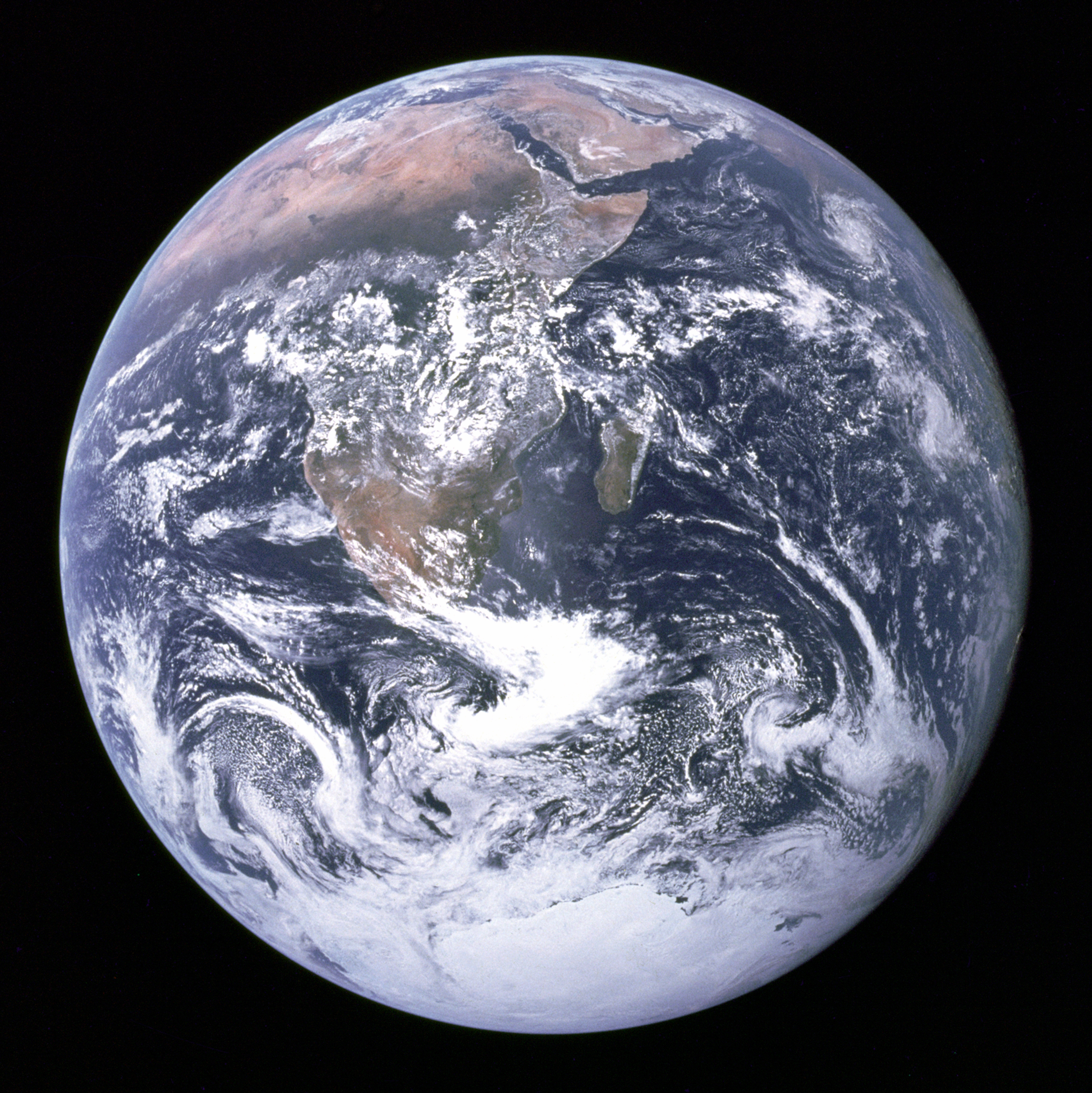


The Blue Marble; work of God?
Jack
AFTER THREE ATTEMPTS TO TRY TO CONTACT 'PAUL' I RECEIVED THE FOLLOWING:
DR DINO:

Dear Jack,

Still here!
Still answering questions!
But ... I just cannot do Email debates.
Sorry. -Know too much. Can't go back to darkness.
Please ... watch some of Dr. Hovind's seminars and/or debates.
Best Wishes, Paul

AND BACK AGAIN:
Why can't you do email debates? Is it that I can respond with correct facts faster than you can find 'true' ones?

I'd be willing to talk over Skype... but due to time differences it may be a little challenging.

It seems odd that at the beginning of out 'debate' you were happy to reply quickly and efficently, but now you've realised that I can answer your points (and I don't view the Bible as, excusing the pun, gospel are you to give up? good scientists don't tend to give up.

I would watch Dr Hovids seminars, but I find it diffuclt to hear 'science' from someone who has no more qualifications than three degrees from unaccredated organsations... he could at least try.

I await your reply, but fear that you may not be man enough to continue with me

thankyou for your time

Jack 


Drain the Oceans – fill the minds?


Transmitted on the British Channel 4 and the American National Geographic (and potentially other services across the globe – such as YouTube), ‘Drain the Oceans’ bills itself as a ‘ a virtual scientific expedition to the deep as we explore one of Earth's last great frontiers - the ocean’. Moving stuff. So how well does it do this in terms of communicating geosciences?

Well, the first problem the program makers possibly hit upon was the difficulty of conveying the size of stuff in the oceans, the program very rarely utilised quantifiable figures (excluding in heights) so areas of the seafloor became ‘the size of New Hampshire’ or ‘the size of all the dry land on earth’. Both of which are much more tangible thing to get ones head around (admittedly I didn’t know how big New Hampshire was, but old Hampshire is fairly sizeable). Geographically the locations chosen are likely to be known by potential viewers (I’m going by the assumption that this programme was developed in the USA), with the Bahamas, offshore California and Hawaii used as examples.

General language of the programme too was fairly pleasant to a non geologist, given that most of the oceans have a fairly dull petrological component (basalt) there wasn’t much room for error, expert geologists were used widely and occasionally their language was bit technical, but still fairly comprehendible by a non-geologist.

Volcanoes focussed heavily, of course, big bangy things are guaranteed to interest people;. Unfortunately the programme managed to perform my pet hate; utilising footage of a felsic volcano to describe mafic volcanism. Which, although usually preserved until first year university lectures, seems to be a prominent thing within geological TV – please stop doing it! There are other technical things, such as pressure and gas bubbles at depth below the ocean, but I do not own an anorak so they can be forgiven.

Would volcanic eruptions under 2 miles of water generate clouds of ash and gas at those pressures? Simply the film makers are trying to give the public a manner to attach themselves onto the story of generation of oceanic crust by utilizing familiar imagery (magma = volcanoes = big clouds of smoke)
The programme comfortably utilised plate tectonics to explain the oceanic features (Emperor sea mount chain, mid ocean ridges and subduction zones) and managed to sit on the fence of the mantle plume debate. Indicating that ‘some’ scientists consider Hawaii to have been generated in this manner – rarely a programme takes the time and opportunity to indicate to the public the open floor that science is.

Oceanic Spreading is of course accounted for and interestingly different spreading modes altering the topography is introduced, although not discussed in detail, this gives plenty of opportunity for curious minds to keep exploring into the geosciences!

Oddly the programme completely ignores Oceanic Core Complexes, Apart from being a personal interest of mine they are pretty incredible structures, with a huge fault taking up 30-40km of extension and slopes of kilometres in height. The programme appeared to brush past them; yes, their geology is not perfectly clear but there is plenty of opportunity to amaze people in size, composition (all that lovely mantle peridotite) why did the programme step around it so?

Unlike a lot of geological programmes (Men of Rock, Earth Story, How the Earth was Made) the various localities are not tied into a form of storyline (i.e. the generation and destruction of oceanic lithosphere) instead discussion jumps between different areas. This seems to give the programme little flow, almost as if someone chose the different parts of the film from a hat and felt they needed to stitch it together but is understandable since the programme is presenting different facts, not showing the evolution of a theory or a search for facts on a particular topic.

So, is this programme a good example of communicating geosciences? Yes, certainly, although there are minor holes these are more than made up for by firstly the production and transmission  of such a programme and secondly, facts are displayed in an interesting, visual way making the most of modern(ish) technology while utilising experts in the field to give a complete and attractive package. 

Friday, 4 March 2011

Making Footsteps


You may recall, some time ago (news travels slowly to my cave) that a large, exciting dinosaur was identified and tag lined with the term ‘Thunder thighs’ or to people with beards ‘Brontomerus’. Dinosaurs are without doubt the most well known thing about paleontology. More people might study ammonites and microfossils but its the big things that get people interested – does new stories reporting a new discovery get people interested?
Now this is a dinosaur ‘discovery’ so it’s going to get lots of people interested, but will it sustain that interest and get people interested in geology. There is plenty of communication out there, but for this post I’m going to examine the effect of a big geosciences story on patterns of search for a variety of geological terms – and see if there is any great increase as a result.

Blue is 'thunder thighs', red is 'Brontomerus' and yellow is 'paleontology'


So the story ‘hit’ on the 20th, resulting in no change in the search volume for ‘Paleontology’ but a sharp peak (oddly a few days later) for the creatures scientific name: Brontomerus’. This seems a little odd, but what about the effect on ‘dinosaurs’. Oddly there is actually a decrease in searches for dinosaurs, with a small ‘hump’ 5 
days later.

Search volume for 'Dinosaur' note the comparison to the blue line in the above chart. 


The search volume for ‘Dinosaur’ way outstrips that of anything on the above chart – and since there is no real change it can be assumed that there is enough background demand for information on dinosaurs to lead a small story to not cause a great deal of ripples.

Search volume for 'Geology' note slight peak around the 20th, second peak around the 28th is likely related to the New Zealand Quake. 

 A similar story is present for ‘geology’ ; although there is a peak which coincides with the story, a second peak coincides with the New Zealand Quake  – whether this is simply a result of a general pattern of as a result of the story is difficult to attain .The background interest in both terms is a great sign – constant interest which for engaging people into geosciences is clearly a good thing! What does it teach us about communicating geosciences? Well that a news story is just that, its a story, it’s been a week and news has moved on – thankfully there is enough interest in this facet of geosciences to maintain a steady stream of minds looking for information allowing educators to easily plan and generate interesting topics and articles.  

The Oily Elephant in the Room

How are geological and non-geological organisations communicating peak oil? And for the former, why should they?  Why should any geosciences organisation act to educate the public in what is essentially an economical matter?

Other than the fact a lot of geologists depend on the petroleum industry for employment everyone requires oil, and recent price hikes have caused difficulties on a global scale, from pig farmers in Devon to airlines loosing money (again) the looming prospects of demand for petroleum outstripping supply is a concern. We all need oil for our lives. Also, given that geologists, when attempting to communicate geology to the public often utilise global resources in order to make our subject important (oil for fuel, steel for bridges etc....), well if we run out of oil we’ll have nothing to talk about (damn biologists might get a look in).  It seems a good idea to have a look how a couple of different organisations, with different outlooks illustrate peak oil.


The Society has a limited number of resources, mostly in the form of personal writings attacking or promoting the theory. Unlike Climate Change of which a statement is provided Peak oil is instead,  relegated to a conference (of which proceedings are not presented and anyway, would the public have an interest in reading them?) and a personal letter in the Societies Magazine; Geoscientist (available to the public). Even the Specialist petroleum group of the society has only one direct publication discussing peak oil – hardly a great result of outreach.


Virtually nothing on Peak Oil... in fact searching for ‘Peak Oil’ results in more queries on the generation of oil (i.e. Peak Oil production over geological time) and oil companies with ‘Peak’ in their name. There is none of the usual material produced by the USGS in educating the public into particular geologic processes and theories.  This is incredible irresponsible; not only does this lead people looking into peak oil  to have to slightly less reputable and balanced sites (See ‘peakoil.org.uk’) it also indicates that there is no concern about resources becoming limited.


Now, I wasn’t expecting much from a nice big oil company, but this was amazing.
On the home page I was greeted by a nice flash animation telling me ‘Global energy demand in 2030 will be 35 percent higher than in 2005’ and that Exxon’s tagline is: ‘Taking on the world’s toughest energy challenges’.
Upon searching the Exxon Mobile site (with the site’s search engine and Google) there are no direct results for Peak Oil (i.e. articles that feature that term). Now, given that Exxon are known for having involvement in various governmental organisations, but do not accept peak oil on their website this is a major consideration, particularly if a concerned (and savvy) member of the public  went searching for resources from an organisation you’d think might have an inclination as to the upcoming risk of resources running out! This could be an indication for a Global Warming like fight with Oil giants as the problems of Peak Oil

BP – Beyond Petroleum:


The site actually has a flashy little interactive animation that touches upon ‘resources will struggle to keep up’ but that’s about it. Shell energy scenarios to 2050 does not mention ‘peak oil’. While searching for ‘Peak Oil’ recommends that I look at lubricants responding at 'peak times of stress' in engines. Failing that articles it does generate appear to not have the two words together. What is it with Oil Companies? Almost like they don’t want to accept Peak Oil.

And in the green corner: Greenpeace:

Not a particular fan of them, but out to give them some air time. Oddly this site is not crawling in Peak Oil information, but gives an acceptable biased opinion of the economic forces behind peak oil. No results had anything related to geology (a bit on rock music and peak oil). Surely the threat of energy security is the perfect opportunity for Greenpeace to get people concerned and campaigning? Maybe not. 


On an interesting side note, the UK’s ‘All Party Parliamentary Group on Peak Oil & Gas’ a governmental policy group who can’t really make policies or do anything (I called to ask) but still have voices in Westminster has as its five main roles people Greenpeace members – I’m not being political or difficult. Just surely with that sort of involvement surely Greenpeace could have put together more of a show!


Having been so pleasant to this site in a previous post I now need to be a little bit mean; following in the footsteps of Exxon, USGS, and GeolSoc of London; Geology.com does not have any resources for Peak Oil, various articles and news reports discuss particular oil feeds reaching ‘peak’ production, similar to that on offer with the USGS.

So, there is limited information from NGO’s and even Government Organisations.  Where can the public go to get information on Peak Oil? Well it seems that a casual reader (ie someone using Google!) will be presented by 38 million results; since I don’t have the rest of my life to ponder, I’ll choose the top 4 to analyse:
1              Wikipedia; http://en.wikipedia.org/wiki/Peak_oil.
Really really good article; thorough, balanced (well, as balanced as Wikipedia gets on an environmental issue) with heaps of references. As I’ve already demonstrated in earlier blogs Wikipedia is often used to access quick information – and this page well deserves to be on the top of the list. I can imagine that it is a well used resource for people looking into Peak Oil. Just don’t reference it.
2              Broken link: www.lifeaftertheoilcrash.net; as the second response from Google. Fire up the alarm bells.
3          Peak Oil http://peakoil.org.uk/ [note – I’m writing this in the UK, Globally different areas may generate different results – I truly hope it does]. A pretty poor site from a Sociologist with an interest in peak oil and writing websites who’s site consists of, in the majority pictures of publications and opinion.... this is at number 3 in Google searches!
4              Peak Oil.com http://peakoil.com/ - exploring Hydrocarbon depletion. An online community, so a mixture of interested parties, knowledgeable parties and lunatics.  Looking into these boards they are utterly useless; with a variety of obscure topics which are not suitable to demonstrate peak oil to the public.

So why is there no decent, reputable (sorry Wikipedia, it's not you, its 'established science') site for information on Peak Oil? Well, unlike Climate Change its fairly difficult to prove, there is no evidence in the geological record of resource peaking, what it does have in common though is money – both issues are threatening Oil Companies, who neither governments nor their shareholders are particularly interested in educating the public and customers as to a potentially rapid alteration in lifestyle.  It seems wise then, to observe how interest in peak oil has, to excuse the pun, peaked and fallen: 

Search Volume top
News volume bottom


It can be seen that there is clearly interest in Peak Oil, with strong peaks roughly coinciding with news (middle of 2008) during 2005 there is a massive amount of interest, despite limited stories – although there has been some commentary as to that year being ‘Peak Oil’. What, from the perspective of geoscientists wanting to communicate can this tell us? Well from looking at the available resources there is a severe gap in the market for sensible discussion, potentially from a governmental viewpoint (although that is probably just dreaming) which incorporates geosciences. After all, mitigating or confirming peak oil will fall to people out there, looking for the stuff. It beggars belief that there is so little out, available for such an important topic, a topic which has 10% of the searches of ‘Global Warming’


Global Warming in Red
Peak Oil in Blue. Representing 10% all searches in comparison to 'Global Warming'

 On an ending note:
According to BP, global oil reserves were 1,333bn barrels at the end of 2009. That was 23 per cent higher than a decade earlier, despite consumption of 300bn barrels over the period. (Financial Times)


Thursday, 24 February 2011

REEaly a concern?

So, Rare Earth Elements are becoming a little bit short;

and threatening our non elemental lifestyle of ipods and (hopefully soon!) battery powered cars. This ‘shortage’ is in my opinion more of a political problem and a resource problem, with 95% of the supply of these elements originating in China and the government there looking to lower exports, presumably to prop up its high tec manufacturing industries at the cost of western jobs.
But this isn’t a blog into politics, however interesting it may be, this is about communication geosciences. So where does this fit into that framework?

Well we could use the increase in prices of electrical items to get people interested in minerals, after all these REE’s seem to reside as a accessory phase within a variety of different rocks and minerals. Or bounce off the REE’s shortfall to discuss the environmental effects of minerals important to the ‘green revolution’:


Searches for Copper (Google Trends)

 Firstly, though it would be good to check if there is a market; see if people really care about where minerals come from? Well Google track a certain number of searches for statistical analysis, and within Google trends, users can see how much interest is generated.
Looking towards copper (since most REE’s don’t generate enough interest) we can see that searches for ‘copper’ as a term have fallen over the last six years, despite the news coverage regarding its shortage increasing and the price in the last 3 years ballooning.


Searches for 'Copper Ore' (Google Trends)


Now if we also take into consideration that ‘copper’ is far from a geological concept, instead we need to use a term that interested parties may search in order to gain greater insight into copper generation. Copper ore, which would be the logical thing to type if you wanted to know what it was and how you get it. This too doesn’t seem to be bourgeoning with popularity, despite prices peaking in the past few years, the search queries have remained stable in the last 5 years.
  
Does this mean that people are looking less into the generation of ores? Of course, it doesn’t, this is one term, further research into this could well generate more interesting patterns. Also it doesn’t take into account


Searches for 'Geology' Google Trends)

Although searching around there is a more interesting pattern, over the last 7 years there has been a steady decrease in the number of searches for ‘geology’ Despite the news volume increasing (coinciding perfectly with the Boxing Day Tsunami) which highlights something else, unless there is a background interest, events need to occur in order for interest to be generated.  Is recent price increases to REE’s and the media coverage that has explored the trigger? I guess we'll just have to wait and see.


Tuesday, 22 February 2011

No Lasting Shock.

As in geology, the present is the key to the past, so with the media quake over
Christchurch’s recent devastating earthquake  ongoing it seems prudent to see how
interested people were in geology last time this happened. A similar, although less devastating event occoured in September 2010. Which resulted in There is a massive peak in searches for ‘christchurch earthquake’ (blue) in September of last year, presumably due to this: http://bit.ly/gKU4Ht. The red line demonstrates searches for ‘earthquake causes’  which gives no change at the September 
event.
Search volume for Christchurch Earthquake (Blue)
Earthquake causes (Red)


Comparing these results to other terms, such as ‘seismic’ or ‘plate tectonics’ there is a
similar story (see diagram below);  In fact looking at a variety of terms related to the quake (Canterbury Plains, ring of fire, pacific plate) do not have any alteration in their search patterns at the time of the event.

Search Volume for:
Blue: Christchurch Earthquake
Red: Plate Tectonics
Orange: Seismic
Even today, where the 10th most searched term in the English speaking world is ‘Christchurch
Earthquake’ (Aelxa) it is beaten by Justin Biebers new hair cut and the ever popular Rihanna. There has, to present been no change in search traffic for geologic concepts.  If someone does search for the terms highlighted above there is plenty of really good information, from a variety of sources – even if people don’t look for it after an earthquake


What are we to learn from this? Well simply, people want to know the story, but do not want to know how it works. As previously discussed in this blog, people are interested in the stories of people. Not rocks.


Finally, my thoughts go out to the People of Christchurch. I wish you all the best during this time. 

Sunday, 20 February 2011

Looking Closely

The importance of practical geosciences to the public tends to focus in on petroleum or engineering. Base metals and REE (Rare Earth Elements) tend not to get a look in, until their shortage threatens society. Price hikes combined with increased demand have raised the media profile of a variety of minerals, from the important copper to the ever growing in importance REE in the electrical industry.  

The only real aspect of mining people see is either the end product, the huge holes in the earth dug to extract the material, or the people who extract the ore (and then get stuck). Economic geology, the field that deals with the economic potential of areas of rock tends not to get a great deal of press coverage - fewer than 1000 articles on Google-News discuss economic geology, with only 4000 articles tied to ‘mineral exploration’, compared with ‘oil exploration’ that generates over 11,000 articles. Even though, metal prices are at all time highs. ‘Mainstream’ press appears to completely ignore mineral exploration;
The Daily Mail, although only utilised by myself as something to get annoyed with has only a handful (10!) stories on mineral exploration, while oil exploration generates 450 odd, looking to a more educated paper, the Independent, mineral exploration yields just over 100 results, while petroleum exploration strikes around 1500 articles (oil exploration; 340). The UK’s most read paper, the Sun finds 45 articles under the search ‘oil exploration’ (although most seem to be on BP or the Falklands) while looking for minerals  provides 2 results – one of which is on Mars.

So, why the public dis-interest in  the mineral industry when it is the backbone of virtually everything we use everyday; from the laptop I type on, to the knife I butter my toast with? Well, the UK doesn’t really have much of a mineral exploration industry because of cheap imports and exhaustion few people see the effects of mining; with the majority of mines operation in countries far beyond our borders.

When an oil spill occurs, be it Deepwater horizon, Exxon Valdeez or the Esso Portsmouth off Milford Haven it’s all over the news, black gold coating seabrids, stones and beaches, the idea of striking oil in a romantic vision of derricks and desert. While few people (bar myself) get excited by the prospect of discovering copper. On the surface oil is a lot more visible as a commodity, cars are ubiquitous, we all require petrol/diesel for our daily lives, whether it gets us to work, delivers our food to the supermarket or provides us with a livelihood. While the usage of minerals isn’t immediately obvious – we are all in constant contact with something derived from the earth (be it the dye in our clothes or jewellery).

So how can the economic area of the geosciences and the importance to society are broadcast? There is the usual manner of showing people a bit of ore and the pointing to something nice and shiny. But there is so much more to an ore than that; from my limited (at present) experience of ores I feel that simply showing a hand specimen isn’t all that; remembering the first time I looked at a thin section, I was captivated (seriously, not kidding!) by the beautify of the slide, learning more about them what can be seen from a sliver of rock is amazing;  why not bring this subtle beauty to the public? A rock is a rock, but people love to look at close up images of hair, dust and plants – a close up image of an ore shows so much more, a story almost!

The public rarely see this, I have been fortunate enough to volunteer at events where the public have had an opportunity to observe what every geology student either loves or hates. Generally they are interested – the chance to make granite more than that grey rock or to see every grain in a sandstone seems to interest people. Yet most of the public never have the chance to be captivated.

Can one blend the subtleties of economic geology, the need for minerals in our society and a new way for people to look at rocks? Well, I’ve already discussed how myth’s and stories brought the geosciences to peoples before modern science and today are still used in popular science books – why not use the same approach to bringing the components of today’s society to the public? Illustrate how an ore forms, from (depending on the type) a gentle crystallization, with hydrothermal alteration via miscropacy.

Now, wait, I know miscropacy needs some skill to interpret, but as does a hand specimen; and an image of a rock is a novelty, anytime someone can pick up a rock, but few can slice it into a slither and see what it really looks like.  

What other ways are there to get the public interacting with the minerals that make their society? Short of visiting a mine there are few; the story of how an ore forms is just that a story; one that should be told – and looking closely is, in my mind the best way to do it.